Virtual Private Cloud (VPC) Explained – Secure & Scalable Cloud Networking Made Simple
Introduction
In today’s digital age, companies require strong, adaptable, and secure infrastructure to run their applications and data. Cloud computing is the foundation of modern IT, yet many organizations remain concerned about security and control. Enter a virtual private cloud.
At bsoft.co.in, we assist businesses to capitalize on cloud technology with the best performance and security at right cost.
What is a Virtual Private Cloud?
Virtual Private Cloud (VPC) represents a Private Cloud conducted over a Public Cloud where you can run your applications and keep your data secure. But because it runs on the shared cloud infrastructure, your VPC remains isolated from other customers.
It’s like having a private apartment in a big building. The building (cloud provider) is shared, but you have full control over and responsibility for your apartment (VPC).In virtual private cloud, you get:
- Dedicated virtual network
- Custom IP address range
- Subnets for organizing resources
- Advanced security controls
What is the Working Principle of Virtual Private Cloud?
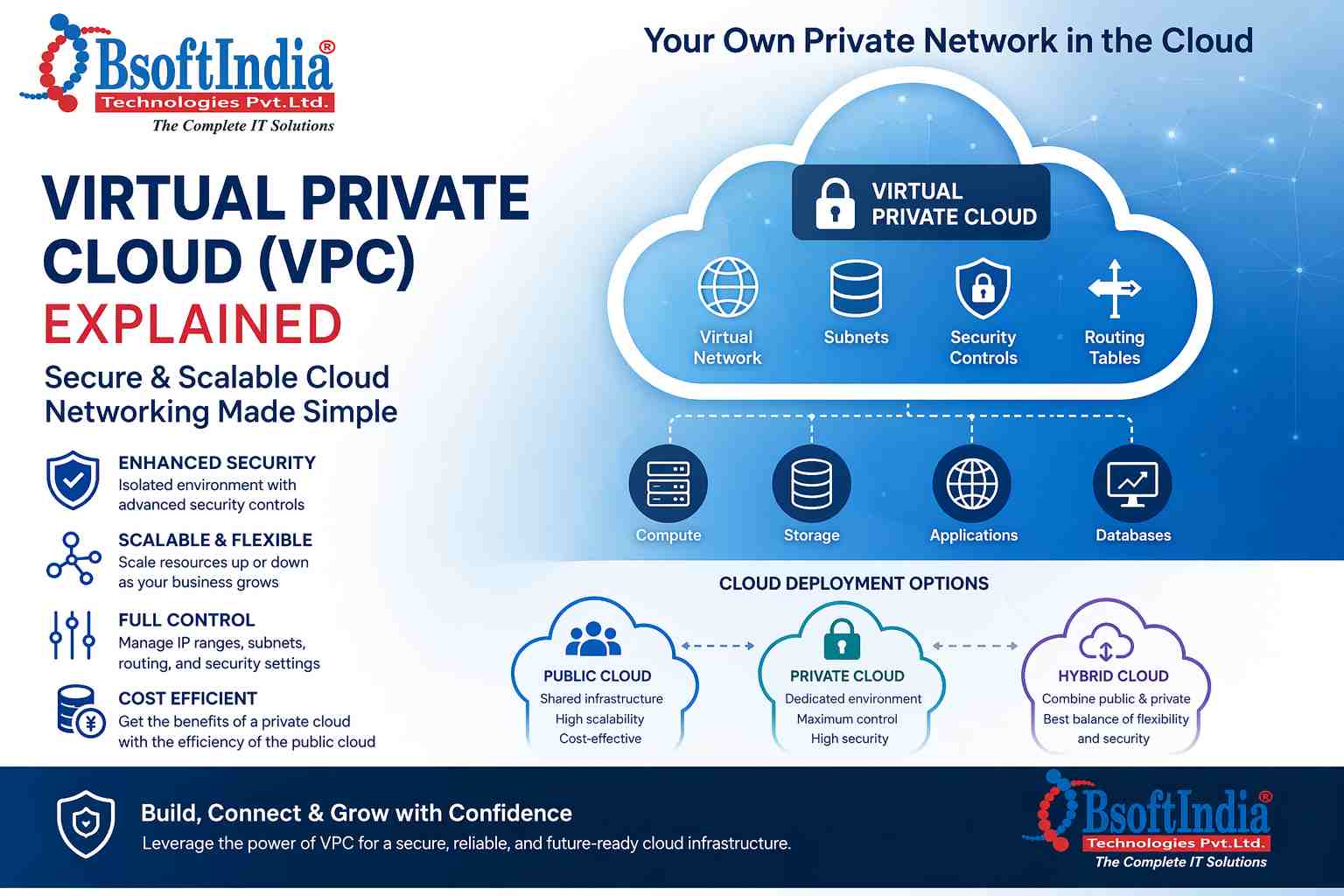
A virtual private cloud is a private cloud within a public cloud built on virtualization technology. Cloud vendors logically segregate resources such as servers, storage, and networking elements to ensure isolation and security.
Core elements of a VPC are:
1. Subnets
Your VPC can be divided into multiple subnets. Depending on your requirements, you may deploy a public and/or private subnet.
2. IP Addressing
You can use your own private IP range, which means you have total control over how your network is set up.
3. Routing Tables
Routing policies determine the flow of traffic in your VPC, and from it, to other networks.
4. Security Layers
Firewalls, security groups, and network access control lists (ACLs) ensure that your resources are safe from the bad guys.
Virtual Private Cloud vs Public Cloud vs Private Cloud
Know the differences between cloud types to help you select the right one for you.
Public Cloud
Public Cloud is a multi-tenant infrastructure where resources are shared among different users through the internet. It could be controlled and customized but it is less scalable and more expensive.
Private Cloud
A Private Cloud is single-tenant. It offers the highest levels of security and control, but it is the most costly to maintain.
Hybrid Cloud
A Hybrid Cloud is a Public Cloud & Private Cloud combination that enables organizations to achieve the optimum balance between flexibility and control.
Where does VPC fit in
A virtual private cloud bridges the gap by providing:
- Security of a Private Cloud
- Cost savings of a Public Cloud
- Flexibility to work in a Hybrid Cloud environment
Advantages of VPC
1. Better Security
A virtual private cloud makes sure that your data and applications hosted are segregated from other users. You can enforce access controls and encryption.
2. Full Network Control
You can define your network architecture—IP ranges, subnets, routing policies, and more.
3. Scalability
You can scale VPC resources up and down without any downtime as your business grows.
4. Cost Efficiency
A virtual private cloud is less expensive than a Private Cloud because it’s built on shared infrastructure.
5. Seamless Integration
VPC integrates well with Hybrid Cloud solutions, End Your On-Premise Systems With Cloud Resources! VPC offers flexible, secured connections among your on premise system and cloud system.
Use Cases of Virtual Private Cloud
1. Business Application Hosting
Companies are able to run ERP, CRM, and accounting applications within a virtual private cloud securely.
2. Storage and Backup of Data
VPCs offer a safe place to store sensitive data and back it up.
3. Testing and Development
Developers can build isolated environments for testing applications that do not interfere with production systems.
4. Disaster Recovery
With VPC, companies can create robust disaster recovery solutions in the cloud.
Conventional hosting environments are typically inflexible and do not include advanced security features. Benefits of virtual private cloud include:
- High performance with dedicated virtual resources
- Increased uptime and reliability
- Powerful security options
- Scales easily without hardware upgrades
At bsoft.co.in, we offer customized VPC solutions designed for your business needs to provide high performance and security.
Virtual Private Cloud in Hybrid Cloud Strategy
By utilizing a Hybrid Cloud, organizations are able to host sensitive data in a Private Cloud and use the Public Cloud for scaling.
A virtual private cloud is important because it:
- Serve as a secure tunnel between environments
- Allowing for data movement and workload balancing
- Business continuity support
This combination guarantees the best performances without loss of security.”
Virtual Private Cloud Security Features
One of the highest benefits of virtual private cloud is security. Key features include:
- Network isolation
- Firewall protection
- VPN connectivity
- Data encryption in motion and at rest
- Multi-layer authentication
These attributes allow the VPC to the well suited for the financial services, health care and e-commerce industries.
How to start with Amazon Virtual Private Cloud?
Establishing a virtual private cloud includes:
- Selecting the Best Cloud Provider
- Specifying IP address range
- Subnets and routing rules are then made.
- Security policies set up
- Roll out Applications
If this sounds daunting, you’re not alone. bsoft.co.in provides complete solution for VPC implementation and VPC management services free from the usual complications.
Why bsoft.co.in for Virtual Private Cloud Services?
At bsoft.co.in, we provide stable and secure cloud solutions for small, medium as well as large enterprises. Our services include:
- Tailored VPC provision and set-up
- Hybrid Cloud/environment stitching
- High-performance infrastructure
- 24/7 support
- Cost-effective plans
We make sure your virtual private cloud is fast, secure and scalable.”
Conclusion
The most appropriate choice for a company looking for a Public Cloud’s flexibility with a Private Cloud’s security is VPC. It offers full power over your network control your data and grow your business.
If you are a startup or an enterprise, implementing a VPC can change the way you perceive your IT infrastructure. With specialized assistance from bsoft.co.in, you can harness the full power of cloud computing and maintain your lead in the competitive digital space.
FAQs
1: What is a virtual private cloud?
A virtual private cloud (VPC) is the subset of the public cloud where you can define your own virtual network and control aspects such as IP address ranges, subnets, and Access Control Lists (ACLs).
2. Is VPC secure?
Yes, a VPC has good security features like firewalls, IPsec encryption, and network isolation.
3. What is the difference between VPC and Private Cloud?
Private Cloud is a completely dedicated environment while VPC is a virtual private environment within a shared cloud infrastructure.
4. Can VPC be used in Hybrid Cloud?
Yes, VPC is also known to be heavily applied in Hybrid Cloud configurations for bridging of on-premise to cloud.
5. Why choose bsoft.co.in for VPC?
bsoft.co.in delivers safe, scalable and cost effective VPC solutions with professional support.